
Congress leader Rahul Gandhi launched a scathing attack on the BJP-RSS, labelling them a "bunch of jokers" with no understanding of India, and criticised Prime Minister Narendra Modi's foreign policy as merely "hugging leaders." He also claimed the RSS has become an instrument of large capital, serving Adani and Ambani, and vowed that the Congress would keep pressure on the government until Modi and Shah resign. The BJP hit back, calling Gandhi immature and out of depth.

Congress leader Rahul Gandhi has criticised Prime Minister Narendra Modi's foreign policy and his remarks referencing the COVID-19 pandemic in relation to the West Asia situation.

An article said Modi's decision to provide e-visas for Chinese nationals is inadequate and it should be extended to business and work visas.

There has never been a moment in India's history when it has been so adrift in the world, so confused about what it stands for and against and so humiliated, asserts Aakar Patel.

We should reassess what India's role in the world is and whether we are doing the right thing for ourselves, notes Aakar Patel.

This might help explain why our global outreach has received such a tepid response. We have chosen to be transactional with the world, as our UN votes reveal, points out Aakar Patel.

US Secretary of State Marco Rubio stated he does not believe India and Iran are pursuing a trade deal, despite a recent meeting between their leaders. He acknowledged that many countries engage with the Iranian regime but reiterated President Trump's warning against helping Iran evade sanctions, threatening penalties for nations that do so.

Russian Foreign Minister Sergey Lavrov has publicly supported India's bid for a permanent seat on the United Nations Security Council. He stated that any reform of the UNSC should not grant additional seats to Western countries like Germany and Japan, citing their "militarism and revanchism." Instead, Russia advocates for increased representation from Asia, Africa, and Latin America, specifically backing India and Brazil, while also emphasizing the need to address African interests.
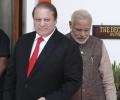
Two years of Modi's foreign policy can be best remembered for its flip-flops on Pakistan and the PM's blockbuster speeches to delirious non-resident communities and the grand receptions he has received.

Prime Minister Narendra Modi lauded India's 7.8 per cent GDP growth, achieved despite global conflicts and instability. He emphasised the importance of Swadeshi and self-reliance for a developed India by its 100th year of Independence, urging citizens to avoid unnecessary foreign expenditures.

Prime Minister Narendra Modi, in bilateral talks with Chinese President Xi Jinping, emphasized that both nations must show sensitivity to each other's core issues and be guided by mutual respect, sensitivity, and interest. Modi highlighted the critical importance of peace and tranquillity along the Line of Actual Control for the development of India-China relations, while also addressing concerns regarding Taiwan and Tibet.

The successful hosting of the 18th BRICS summit in New Delhi has provided a significant boost to the BJP, offering a timely opportunity to strengthen its narrative against the opposition ahead of crucial assembly elections next year. BJP sources highlight the BRICS grouping's strong condemnation of the Pahalgam terror attack and the consensus declaration as major diplomatic victories for the Modi government, countering criticisms of its foreign policy. The party plans to leverage these outcomes during its month-long Seva Sankalp campaign to connect with various sections of society.

Congress leader Rahul Gandhi on Friday accused External Affairs Minister S Jaishankar of "collapsing" India's foreign policy and questioned the government's handling of the recent tensions with Pakistan, particularly the US President Donald Trump's role as a mediator. Gandhi's remarks come amidst a war of words between the Congress and the ruling BJP over their leaders' statements on the Indo-Pak conflict.

Prime Minister Narendra Modi has outlined a comprehensive plan to empower India's youth, including training one crore youngsters in artificial intelligence skills and providing free online coaching for competitive examinations, aiming to position them at the forefront of the nation's journey to become a developed nation by 2047.

Narendra Modi's promise to allow states a bigger say in strategising and building foreign policy is unexceptionable, says TP Sreenivasan.

'If Modi were to be elected, he would be part of a coalition government, and within that he would have to take this minority into account. Muslims cannot relate to the idea of Hindu nationalism. Although it is presented as a pan-Indian idea, it appears to them to be exclusive.'

From early indications, the Modi government's foreign policy seems to be pragmatic and reciprocal, says K G Suresh.

When S Jaishankar became India's external affairs minister in May 2019, he was largely considered a political lightweight despite his undisputed mastery over foreign policy.
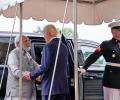
Foreign policy is always a work in progress and ups and downs are built into foreign policy process. What is permanent is national interest. Hopefully, this year, which will also witness general elections in the country, will also clear clouds in the foreign policy horizon, observes Rup Narayan Das.
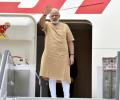
'In these days of a communication revolution, was it necessary for him to go to every country?' 'Mahatma Gandhi had no internet or a twitter account, but the whole world recognised him as the greatest leader of the twentieth century,' says Ambassador T P Sreenivasan.

Israel has implemented new aviation security directives, barring pilots and cabin crew from countries without diplomatic ties, including Pakistan, from entering its airspace. This follows a hijacking attempt last month on a flight to Israel, where Indian Captain Smit Machchhar was injured while thwarting the plot. The restrictions affect over two dozen nationalities and have prompted airlines like Air France and United Airlines to adjust crew assignments.

'Modi's initial forays into foreign policy had the flavour of Aswamedha Yagas launched by ancient kings to conquer the world.' 'He overcame the hesitations of history and explored unconventional ways to win friends and influence people.' A fascinating excerpt from Ambassador T P Sreenivasan's new book, Modiplomacy -- Through a Shakespearean Prism.

US Vice-President J D Vance's unexpected phone call to Prime Minister Narendra Modi on August 8 has ignited speculation about a potential diplomatic overture, possibly seeking India's support amidst the escalating US-Iran conflict and a shifting global power landscape, suggests Ambassador M K Bhadrakumar.
The Congress party has criticised the Modi government on the first anniversary of the Pahalgam terror attack, stating that Pakistan has gained global respectability due to the failure of Prime Minister Narendra Modi's foreign policy.

If the new MDR regime is rolled out from the middle of this month, as scheduled, it should count as one of the boldest political actions by the Modi government on an economic-policy issue, and a signal that it is less worried about erosion of political capital it draws from one of its key constituencies, notes A K Bhattacharya.

India looks less equal to China than 5 years ago, the strategic alliance with the US is hobbled by trade, and Pakistan is looking anything but chastened by Balakot. What has gone wrong? asks Shekhar Gupta.

External Affairs Minister S Jaishankar stated that the world is entering an age of flux marked by conflicts and tariff volatility, requiring India to respond effectively to these challenges. He reiterated India's consistent stance on the Russia-Ukraine conflict, advocating for dialogue and diplomacy, and highlighted India's efforts to engage with both sides. Jaishankar also emphasised India's role in championing the voice of the Global South and navigating complex strategic partnerships in a multi-aligned world.

Marco Rubio will visit Mumbai and Jamnagar to discuss energy cooperation as S Jaishankar says India-US trade talks are nearing a landing point, with a few issues unresolved.

Economists highlight that resolving domestic policy bottlenecks, particularly through land reforms and improving the ease of doing business, will be critical for Prime Minister Narendra Modi's 'next-generation reforms' and India's economic transformation towards its 'Viksit Bharat' vision for 2047.

Sharad Pawar objected to comparing PM Modi with Jawaharlal Nehru, highlighting Nehru's sacrifices and nation-building contributions.

India-US ties may be strained, but abandoning the relationship is not the answer; India must deal with Washington firmly without becoming either servile or hostile, asserts Ambassador T P Sreenivasan.
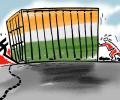
Next week's three-nation foreign tour of Prime Minister Narendra Modi will see India and Oman sign a free trade deal. The visit will also pave the way for agreements with Ethiopia and Jordan to increase India's bilateral trade and investments.

An innovation roadmap, a mechanism to double annual bilateral trade within next five years, and a joint artificial intelligence framework were among 13 outcomes to emerge from wide-ranging talks between Prime Minister Narendra Modi and President Emmanuel Macron on Sunday.
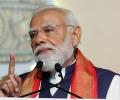
Prime Minister Narendra Modi has urged for restraint in the use of petro products due to the West Asia crisis, emphasising the need to save foreign exchange and reduce the impact of war. He also highlighted India's progress in solar power and ethanol blending, while assuring support to Telangana's development.

Modi thanked Seychelles for the honour and dedicated it to the nations which are fighting the challenges of climate change.

'Foreign policy-making cannot be shifted out of Delhi and the regional satraps, who do not have a national perspective, should not be allowed to dominate foreign policy. But regional inputs should be integral to foreign policy-making at every step of the way,' says Ambassador T P Sreenivasan.

'Our leaders, including Mallikarjun Kharge and Rahul Gandhi, are in touch with all Opposition parties, including the DMK and the AAP.'
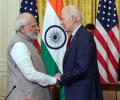
'For the first time since I've been following Indian politics, one heard voters talking about India's role on the world stage and the fact that, due to Modi's leadership, India was once again a great power.'

In recent years, China and Russia have pushed for de-dollarisation within BRICS, which India has resisted. One reason is that India does not want to hurt its relationship with the United States, and another is the fear of China controlling trade because the renminbi is considered the strongest currency in the bloc today.

New Delhi must look for formal, institutional statements issued directly from Washington rather than rely on casual pronouncements meant for local audiences, notes Ambassador Rajasekhar.
